
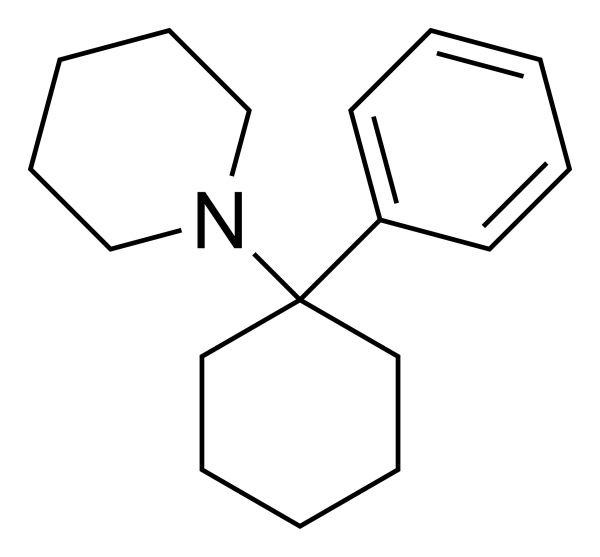
PCP
Phencyclidine (PCP, “angel dust”) is a synthetic dissociative drug originally developed as an anesthetic, but banned due to severe side effects.
The drug causes distortion of perception, hallucinations, a feeling of detachment from one’s own body, and aggressive behavior.
History and distribution
Phencyclidine was first synthesized in 1956 as an intravenous anesthetic. Initially, it was considered as a promising tool for surgical operations, since it caused anesthesia without respiratory depression, unlike other drugs of that time.
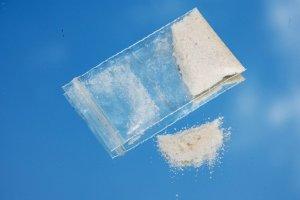
A bag of drugs and a syringe
However, already in the 1960s, its medical use was abandoned due to severe side effects.:
hallucinations, delirium after coming out of anesthesia;
psychotic reactions, including paranoia;
long-term perceptual impairments in some patients.
By the end of the 1960s, PCP began to appear in the street drug culture, and in the 1970s it began to be widely distributed under the names: “Angel dust”, “Crystal” (in the form of powder or tablets).
During this period, it was often mixed into other drugs (for example, LSD or cocaine) or sold under their guise.
Today, PCP is produced illegally in underground laboratories. Despite its relative rarity, phencyclidine remains one of the most dangerous drugs due to its unpredictable effects and high risk of psychosis and violent behavior.
Effects and consequences of PCP
Phencyclidine is one of the most unpredictable drugs that can transform a person into another person in a few minutes. The effect begins after 5-30 minutes and lasts approximately 6 hours (at high doses — up to 48 hours).
At first, PCP can cause a feeling of lightness, euphoria, detachment from reality. Some describe it as an “out of body experience” or a state of weightlessness. However, pleasant sensations soon change:
distorted perception — sounds seem muffled or, conversely, deafeningly loud, and surrounding objects change shape.;
by losing touch with reality, a person ceases to understand where they are and what is happening, and may not recognize their loved ones.;
sudden outbursts of aggression — under the influence of phencyclidine, people commit inexplicable acts, for example, run out onto the road, jump from a height.
Blood pressure and pulse rise sharply, creating a threat of a heart attack or stroke.
Muscles become numb, movements become abrupt and uncontrollable.
A person does not feel pain — this can lead to severe injuries, the symptoms of which the victim will not feel.
Speech turns into an incoherent set of words, and gait becomes unstable.\
Long-term effects
Even after the effect of PCP passes, the psyche may not recover. Many people develop psychosis, when hallucinations and paranoia do not disappear for weeks, as well as depression and suicidal thoughts — as a “payback” for artificial euphoria.
Irreversible changes in the brain are gradually likely, such as memory loss, decreased intelligence, and emotional coldness.
Overdose
A person with an overdose of PCP behaves strangely: he may freeze in a strange position, not reacting to others, or suddenly fly into a rage, not realizing his actions. Movements become jerky and clumsy, speech becomes incoherent, and the gaze becomes glassy.
Body temperature is rising rapidly, reaching a dangerous 40°C. The skin becomes covered with cold sweat, and the pulse rate increases.
Without medical help, an overdose leads to:
muscle breakdown, kidney failure;
irreversible mental changes;
death from cardiac arrest or overheating.
PCP doesn’t just “let go” after a few hours. It accumulates in the body and can “hit” again even after a day.